
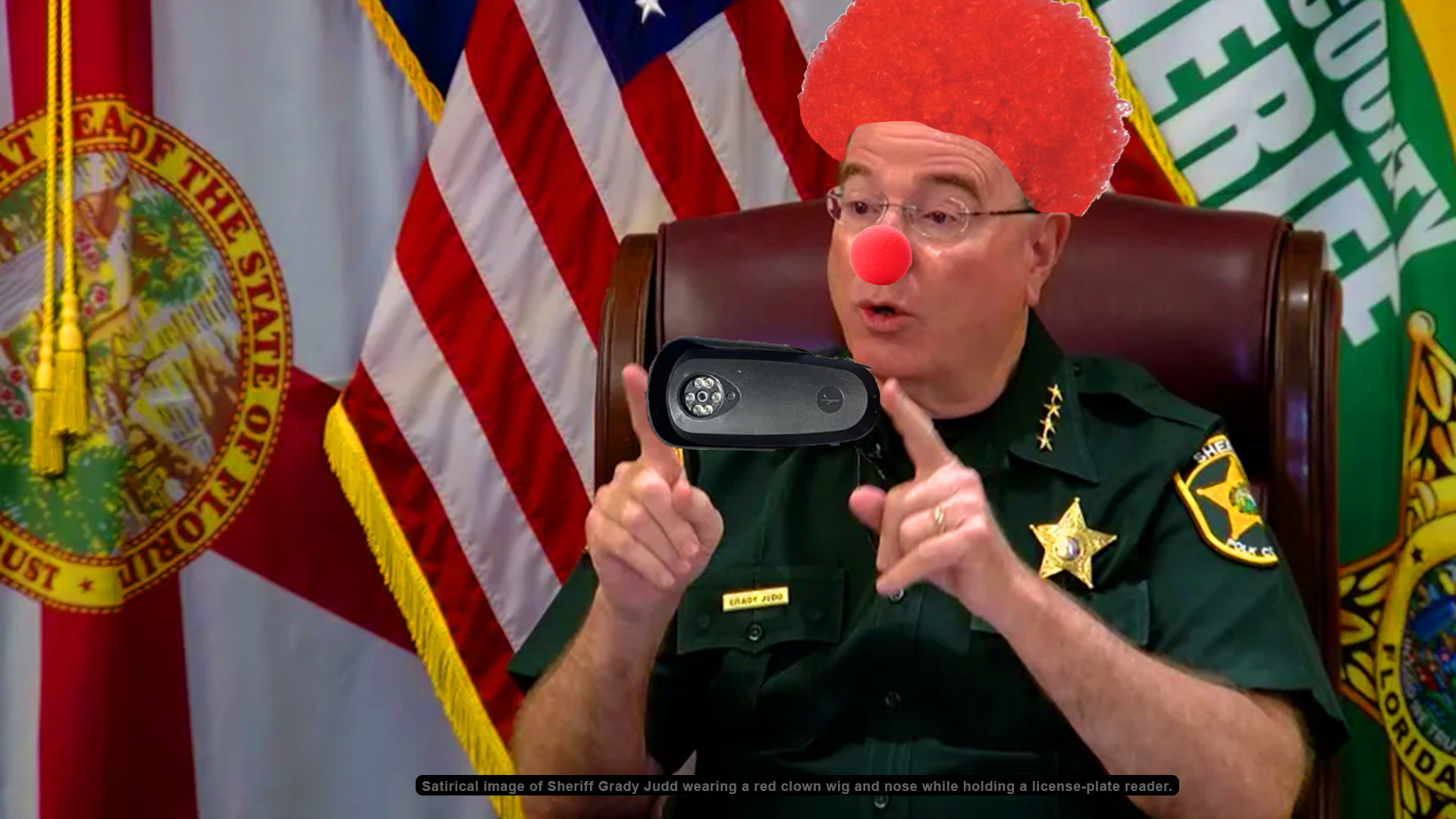
Grady Judd’s Camera Contradiction: Big Brother for Motorists, Privacy for Deputies
Polk County’s longtime sheriff defends cameras tracking motorists, rejects body cameras for deputies, and warned voters about the consequences of property-tax relief.
THE KNIGHT WATCH REGISTER | November 7, 2026 | Investigative Analysis & Commentary
Polk County Sheriff Grady Judd has spent more than two decades cultivating a reputation as one of Florida’s most recognizable law-enforcement personalities. His press conferences are theatrical, his sound bites are rarely subtle, and his tough-on-crime message travels well beyond Polk County. But behind the familiar microphone is a serious question: Does the sheriff apply the same standards of privacy and accountability to his deputies that he applies to the public?
In September 2026, Judd defended Flock Safety automated license-plate readers while reiterating that Polk County deputies do not wear body cameras. He argued that body cameras invade residents’ privacy in homes and other private settings, while plate readers photograph vehicles on public roads. The distinction is real. The question is whether it is enough to justify one kind of camera and reject the other. [Source]
Apparently, privacy is a problem that becomes harder to solve when the camera is attached to a deputy rather than aimed at passing motorists.
Surveillance, privacy and accountability
Automated license-plate readers capture vehicle images, plate numbers, locations and timestamps. They can help identify stolen vehicles or develop investigative leads. They can also create searchable records of where vehicles have been observed, especially when data is collected across multiple sites or shared among agencies. The legitimate investigative benefits do not erase the privacy risks.
Judd’s privacy argument against body cameras is not frivolous. Deputies encounter children, victims of violence and people facing medical emergencies. Yet Florida law already makes certain body-camera recordings confidential and exempt from ordinary public disclosure, including recordings inside residences and other sensitive locations, subject to statutory exceptions. That does not eliminate the risks of recording or storage, but it does show the state has developed a framework for protecting sensitive footage. [Source]
Why, then, are safeguards an acceptable answer for plate-reader systems but apparently not for body cameras? It is a fair question, and one that cannot be dismissed by pointing out that the two technologies operate differently.
The issue reached state government in 2026, when the Florida Department of Transportation directed that license-plate readers be removed from state highway rights-of-way. Judd said his office would comply while continuing to use cameras in other locations. The order was not a statewide ban, and compliance should not be confused with defiance. Still, surveillance concerns had plainly escaped the realm of online arguments and reached the people who control the roads. [Source]
In other words, this was not just a theory assembled with a cork board and seventeen rolls of red string.
Follow the money—and keep the dates straight
Earlier reporting on Polk County’s Flock agreements identified at least 73 cameras and roughly $146,000 in annual recurring charges under the contracts reviewed. Those are historical figures, not a verified November 2026 inventory or current spending total. Camera locations, contracts and obligations may have changed, particularly after the state’s removal directive. [Source]
Judd previously put the cost of a department wide body-camera program at approximately $4 million to $6 million annually. That is not directly comparable with the narrower cost of a stationary plate-reader network: body cameras bring equipment, data storage, records processing, personnel and privacy obligations. But an old estimate is not a substitute for a current, itemized one.
The Sheriff’s Office lists its adopted FY 2026–27 budget on its public information page. Its general-fund budget is approximately $297.3 million, including about $192.3 million for law enforcement. The historical $4 million–$6 million body-camera estimate would amount to roughly 1.3%–2.0% of that general-fund total. This arithmetic does not prove affordability, and it should not be presented as a modern cost estimate. It does show why taxpayers are entitled to ask for updated numbers. [Source]
The county’s September 2026 budget approval is separately documented in the County Commission’s public legislative record. The countywide budget and the Sheriff’s Office budget are different figures and should never be conflated. [Source]
If body cameras are too expensive, show the current numbers. If privacy makes them unworkable, explain why recording policies, access controls and statutory confidentiality protections would not be enough. Neither question requires a dramatic prop at a press conference.
When a camera might tell a different story
Body cameras are not magic truth machines. They can miss events, show only one angle, fail technically or lack crucial context. But they can preserve statements, document conduct, corroborate complaints and protect deputies against unfounded accusations. Without them, a disputed encounter may depend on witness accounts, dispatch records, business security footage and written reports. Those can be valuable; they are not always a substitute for a recording from the officer involved.
The absence of body cameras does not establish wrongdoing by Polk County deputies. It does mean one potentially useful source of evidence is unavailable in routine encounters. For an agency built around gathering evidence, that deserves more than a familiar talking point.
Florida also regulates automated license-plate-recognition data, including retention requirements. Yet the publicly accessible sources reviewed for this article did not establish the Sheriff’s Office’s complete current audit procedures, search-review frequency or present-day Flock inventory. [Source]
If surveillance is essential to public safety, oversight should be essential too. That should not be revolutionary.
Amendment 3 and the politics of public safety
Judd also opposed Florida’s 2026 Amendment 3, warning that property-tax changes could threaten local public-safety funding. That concern had a real fiscal basis: a state economic analysis projected billions in lost local-government revenue over time. Police, fire and emergency services cost money, and a major change in local tax collections can force difficult decisions. [Source]
On November 3, voters approved Amendment 3 with 61.98% of the vote in the Florida Division of Elections’ first unofficial statewide returns, above the required 60% threshold. The amendment expands certain non-school homestead exemptions in phases and changes other property-tax rules. [Source]
Post-election warnings about future hiring constraints should not be treated as proof that earlier predictions were false. A department can experience real budget pressure without immediately laying off employees. Equally, a projected countywide revenue loss is not automatically an identical cut to the Sheriff’s Office. Residents deserve to see the assumptions, the eventual appropriations and the actual service consequences.
Fear may be effective political messaging. It is still a poor substitute for a spreadsheet.
Twenty years in office does not end the questions
Judd has served as sheriff since January 2005 and won another term in 2024. His next regular election is expected in November 2028. Long tenure and repeated electoral victories show political support; they do not eliminate the obligation to explain spending decisions, surveillance safeguards or accountability policies.
Nothing reviewed for this article establishes that Judd personally engaged in corruption, that Polk County deputies illegally used plate readers or that his refusal to adopt body cameras violates the law. The documented issue is a set of public choices: surveillance of motorists is defended as manageable, while recording deputies is rejected on privacy grounds. That contrast is legitimate territory for hard questions.
The people of Polk County are not merely motorists to be monitored, taxpayers to be warned or spectators at the sheriff’s next viral press conference. They fund the office, elect its leader and possess the rights deputies are sworn to respect. Grady Judd has spent decades explaining why law enforcement needs tools to watch the public. It is reasonable for the public to ask why he remains reluctant to put cameras on the people doing the watching.
And no, Sheriff, that question does not require another press conference with props. Just an answer.
Sources and documentation
- Tampa Bay 28 — Judd on Flock and body cameras
- LkldNow — FDOT license-plate-reader removal
- Florida Statutes §119.071 — body-camera confidentiality
- Florida Statutes §316.0778 — plate-reader data
- The Ledger reporting — historical Flock deployment and costs
- Polk County Sheriff — adopted budget information
- Polk County Commission — FY 2026–27 budget adoption
- Florida Division of Elections — Amendment 3 unofficial returns
- WUSF — Amendment 3 fiscal impact and election coverage