
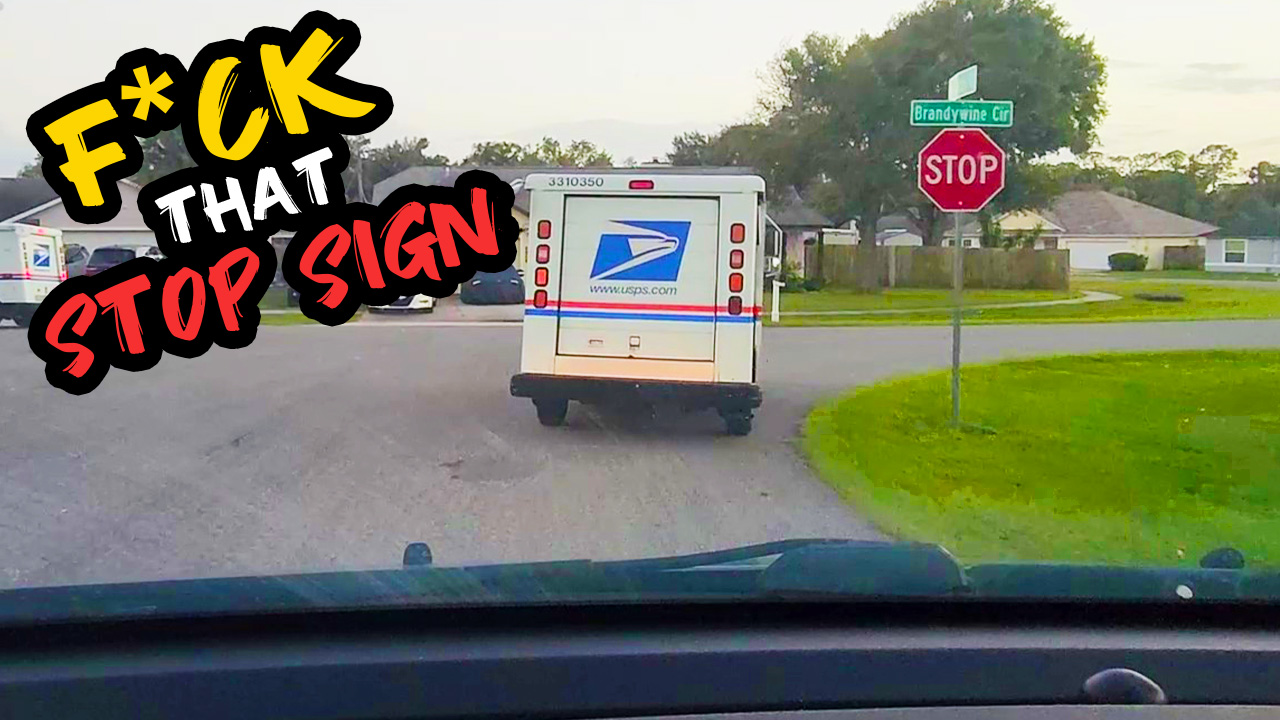
USPS Driver Apparently Rolls Stop Sign in Titusville — While Another Postal Truck Makes a Cameo
Dashcam footage captured a USPS vehicle apparently failing to stop and signaling late at a Titusville intersection. The traffic violations are minor. The accountability question behind them is a little bigger.
KNIGHT WATCH REGISTER
TITUSVILLE, Fla. — A routine drive through a Titusville neighborhood turned into an unexpected lesson in postal service traffic etiquette when dashcam footage captured a U.S. Postal Service vehicle apparently rolling through a stop sign and activating its turn signal too late.
And because apparently one postal truck wasn't enough for a roughly 38-second video, another one showed up.
The footage was recorded at approximately 6:41 p.m. on Oct. 26, 2026, at the intersection of Hennessy Court and Brandywine Circle in Titusville.
The first USPS vehicle, identified by vehicle number 3310350, was traveling southbound on Hennessy Court with the Knight Watch Register dashcam vehicle immediately behind it.
As the postal vehicle approaches the intersection, a STOP sign controlling southbound traffic is visible. The vehicle slows before making a right turn onto Brandywine Circle, but the footage does not appear to show it coming to a complete stop before entering the intersection.
Florida law makes a distinction between slowing down and stopping.
Under Florida Statute §316.123(2)(a), a driver approaching an intersection controlled by a stop sign must stop at the marked stop line. If there is no stop line, the statute specifies where the required stop must occur before entering the intersection.
In other words, the red octagon is not Florida's way of politely suggesting that drivers consider reducing speed.
Then There's the Turn Signal
The same footage appears to show another issue.
The USPS vehicle's right turn signal becomes visible only as the vehicle reaches the intersection and begins making the right turn onto Brandywine Circle.
Under Florida Statute §316.155(2), a driver intending to turn must signal continuously for at least the final 100 feet traveled before the turn.
The statute also requires an appropriate signal when another vehicle may be affected by the movement.
There was.
It had the dashcam.
Violations of both §316.123 and §316.155 are classified under Florida law as noncriminal traffic infractions punishable as moving violations.
And Then Another USPS Truck Appeared
While all of this was happening, a second USPS vehicle entered the scene on Brandywine Circle and performed a U-turn almost directly in front of the camera.
Two postal trucks. One intersection. One dashcam. Less than a minute.
For anyone hoping we had stumbled across some sort of coordinated USPS assault on Florida traffic law, however, there is disappointing news: the second driver doesn't appear to have done anything wrong.
The U-turn appears to have been completed safely, without interfering with other traffic, and no traffic-control sign visible in the footage prohibited the maneuver.
We checked.
Credit where credit is due.
It does, however, make for some remarkably convenient timing.
It's a Stop Sign. So What?
Realistically, this is small potatoes.
Nobody was injured. There was no crash. The postal vehicle didn't barrel through the intersection at highway speed. We're talking about what appears to be a rolling stop and a turn signal that came on too late.
Most people will probably watch the video, shrug and move on.
That's fair.
But the traffic violation isn't really the interesting part.
Accountability is.
Government employees don't stop being subject to the same traffic laws everyone else follows when they climb into a government-owned vehicle. A USPS logo on the side of a truck doesn't turn a stop sign into a yield sign, and it doesn't shorten Florida's 100-foot signaling requirement.
That raises a worthwhile question.
If an ordinary driver performed the same maneuver directly in front of a police officer, could that driver reasonably expect to be stopped?
And if the vehicle instead says United States Postal Service on the side, should the expectation of enforcement be any different?
Knight Watch Register isn't claiming that a police officer witnessed this incident and deliberately ignored it. There is no evidence that happened.
The point is simpler: the standard shouldn't depend on who's behind the wheel or whose logo is on the door.
That principle matters far beyond a rolling stop.
Accountability doesn't suddenly become important only when misconduct is dramatic enough to generate headlines, lawsuits or criminal charges. Sometimes it's something as mundane as a government vehicle approaching a red octagon and apparently deciding that almost stopping was close enough.
Small things are still observable.
Government employees are still accountable for them.
And members of the public are increasingly carrying the tools to document them.
Nobody Was Looking for This
Perhaps the most notable part of the footage is how it was obtained.
This wasn't a planned investigation. Knight Watch Register wasn't following postal vehicles, conducting surveillance or waiting at the intersection hoping someone would do something interesting.
The dashcam was simply recording during an ordinary drive.
The USPS vehicle drove into the frame.
Dashcams, security cameras and cellphones have fundamentally changed the accountability equation. Conduct on a public roadway can be documented by practically anyone, often without anyone specifically looking for it.
That doesn't mean every minor infraction needs to become a scandal.
This one certainly isn't.
But government accountability doesn't require a scandal.
Sometimes it just requires someone to notice.
And sometimes someone just happens to be behind you with a camera running.
Official Sources
Florida Statute §316.123 — Vehicle entering stop or yield intersection